Showing posts with label Art History. Show all posts

Wednesday, April 28, 2010

Frida Kahlo Y Su Mundo at Bozar Expo, Brussels

This was probably the most meaningful exhibitions I have ever seen.
As some of you may know, I am an avid fan of Frida, ever since my Aunt and first Art Teacher, Boo Ehrsam, showed her two me when I was but a wee child.
Naturally, I was completely awestruck at these bizarre, beautiful works. When my Mom came to pick me up from class, I immediately ask her to tell me all about this crazy Mexican woman I had just discovered. (And thus, my Mom had to learn how to explain Frida to a 6 year old...)

I have been waiting a very long time to see her works in person, and am thrilled that my Belgian visit was timed just right.

Frida Kahlo is an all-around inspiration to me, being a thoroughly successful female artists, and having one of the most intriguing, tragic, and adventurous lives. I trust that you have all seen the Frida Movie, staring the beautiful Selma Hayek, so you must surely be familiar with her life (the movie is a rather accurate portrayal) so I will spare you from an incredibly verbose biography (I could go on for days). Instead I will share with you some (almost all) of the pieces from the exhibition (a modest 27 works):

1. El camion (The Bus), 1929

2. Retrato de Alicia Galant (Portrait of Alicia Galant), 1927

3. La nina Virginia (Portrait of Virginia), 1929

4. Retrato de Luther Burbank, 1931

5. Retrato de Eva Frederick, 1931

7. Autorretrato con changuito (Self-Portrait with Small Monkey), 1945

8. Hospital Henry Ford, 1932

9. Frida y el aborto (Frida and the Miscarriage), 1932

10. Unos cuantos piquetitos (A Few Small Nips), 1935

11. Mi nana y yo (My Nurse and I), 1937

12. El difuntito Dimas Rosas a los tres anos de edad
(The Deceased Dimas Rosa at the Age of Three), 1937

13. El pollito (The Chick), 1945

15. La columna rota (The Broken Column), 1944

16. Sin esperanza (Hopeless), 1945

17. La flor de a vida (The Flower of Life), 1944

18. El circulo (The Circle), ca. 1954

21. Fantasy, 1944

24. La mascara (de la locura) (The Mask of Madness), 1945

25. Retrato del ingeniero Eduardo Morillo Safa, 1944

26. Retrato de dona Rosita Morillo, 1944


El diario de Frida Kahlo (Frida Kahlo's Diary), 1944-54
slideshow of sketchbook and photographs


I was fortunate enough to pay a second visit to this exhibition, in which I really got to experience the work itself, instead of feverishly writing and being shoved about in the throws of on-lookers. I was surprised at the size of some of her works; much smaller than what I imagined. But size aside, this was powerful retrospective.

Until Next Time
-Laura

Wednesday, April 21, 2010

Gustave Van De Woestyne - MSK Gent


My latest adventures took me the Gustave Van De Woestyne Exhibition at the Museum voor Schone Kunsten in Citadelpark, Gent. I spent the most time with Gustave's work, but did I have time breeze through some of the other rooms of the museum.
De Woestyne is an artist I knew nothing about prior to this exhibition, and I was completely floored by this retrospective. Undoubtedly, Woestyne has become one of my favorite artists of all time.

Gustave lived and worked in Belgium his entire life (1881 - 1947), save a few years spent in Great Britain during the First World War. He was a deeply introverted, and religiously inspired person which translates through his work, making it thoroughly distinct, and ladened with personality. His work falls into the Symbolism movement of the late 19th century. Originating out of France and Belgium, Symbolism (following the drama and glory of the Romanticists) was a very personal, intuitive, yet a broad geographic reach. Works, specifically those of De Woestyne, mesh the audacity and drama of Romanticism, with the austerity and ambiguity of the "decadent" and Pre-Raphaelites movement.

Woestyne's work was heavily influenced by the previously stated movements, as well as Flemish and Italian Primitives and other iconographic work.
His works contain a subtle yet jarring tension; impeccable draughtsmanship and sheer ability met with knowledgeable and deliberate distortions of figures and other elements. Combined, these elements bring about haunting paintings with classical abilities and avant-garde compositions that are quite timeless.

The exhibition was broken down like any typical retrospective; chronological, highlighting each period of his work. Not so surprising, it was a bit hard to find De Woestyne's work online. Though his work is really amazing, it is not so well known. Here are some of my particular favorites that I manage to capture.


Deeske (1907-08)
watercolor, pastel, pencil on paper

The Blind (1910)

Portrait of Karel Van De Woestijne (1910)
graphite on paper


Self Portrait (1912)
watercolor and oil

Country Girl (1913)
oil on canvas

The Grandmother or Portrait of Roos Van Wijnendaelen (1914)
oil on canvas

The Children's Table (1919)

Portrait of Professor Fabrice Polderman (1919)
oil on canvas

Portrait of Adrienne with a Little Dog (1919)
oils

Christ Shows His Wounds (1921)
oil on canvas

The Liqueur Drinkers (c. 1922)
charcoal and oil on paper

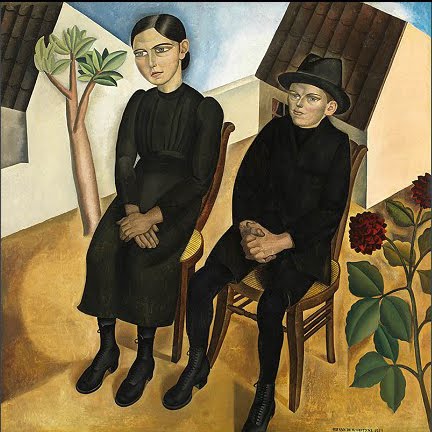
Gaston and His Sister (1923)
oils

Christ Sacrifices His Blood (1925)

Fragments (above and below) of
Christ & His Apostles from the Last Supper (1927)
casein, charcoal, chalk on canvas


His work inspires me in so many ways, I am at a loss for words. The stylization, experimentation, the subtle somewhat dark sense of humor and overall sensibility of the artist really shines through his work. His technique and sheer drawing ability are so in line with my aesthetic It is truly timeless pieces, and I feel as if my art will never be the same after experiencing this show.
Until next time
-Laura

Sunday, April 11, 2010

M HKA


Sorry for lack of posts, everyone. Its been one heck of a week, with midterm reviews, school closing for Easter Vacation (Passavacantie - 2 weeks) and having friends and relatives come in and out of town all week, and doing a bit of traveling myself. I will be backtracking a bit in my art explorations, as to catch up on all the exhibitions I have seen.

On the 3rd Thursday of every month in Antwerp, all of the local galleries and museums hold openings for all of the new exhibitions. With drinks and hors d'oeuvres, ambling through the streets of Antwerp; you could say it is the authentic European experience. On this particular Thursday, I made it just to the Museum of Contemporary Art (Museum van Hedendaagse Kunst Antwerpen - M HKA) to see their current exhibition:

Animism
(1/22/2010 - 5/2/2010)
Part One
A Collaboration between Extra City and M HKA @ M HKA Antwerpen, BE
(5/2010 - 7/2010)
Part Two
@ Kunsthalle Bern

The exhibition/publication project that is Animism showcases the reemergence of animism as a concept vital to contemporary times. The concept outlined by 19th century Anthropologists, such as Sir Edward Tylor (1871 book Primitive Cultures), suggest that animism is the "the theory of the universal animation of nature". Furthermore, Tylor reduced animism to an idea of simplistic concept and perspective on the world at large, that only "primitive" societies would believe in such an archaic and basic evaluation of nature.

This philosophical perspective provides the generalized belief that all animals possess an immaterial soul, hence placing humans and animals within a complex relation to one another. Although it can be assumed that humans have souls, and that humans are a distinct and sophisticated species of animal, we are inevitably just that; animals. Human beings, by nature, have a level of arrogance and a superiority complex that enables us to (primitively speaking) see all objects and subjects possessing human-like qualities and characteristics (i.e. souls, feelings, personalities, etc.). Similar to personification, man's perception of himself in nature can be seen from a child's imaginary friend to idol worship, the concept of "god making man in his image", to a "tribal-like" religion. This arrogance is what also stems the paradox of humans v.s. animals; the idea that somehow we are the superior, dominant species yet we long for the simplicity of existence that animals possess (after all what more could any being want more than to roll in mud and bake in the sun such as a pig? However we may front our disdain and faux supremacy, we still posses the envy and innate desire to be a contented animal).

Comprised of such ideals and philosophies as stated above, as well as each artists individual interpretation and conception; we have the exhibition Animism. The show consisted of installation works, photography, sculpture, performances, and video/film; every visual art form equally represented. Contemporary works meld with historical artworks to fully represent a century's worth of Animism in visual thought. The following images are stills and pieces from the exhibition:


Len Lye
Tusalava, 1929
16mm reduction from 35mm film, 10'

Daria Martin
Soft Materials, 2004
16mm film, 10'30"

Felix Regnault
Hommes negres - marche, c.a. 1870
Chronophotography

Etiennes-Jules Marey
Le vol du pelican, c.a. 1800
Chronophotography

Joachim Koester
Bialowieza Forest, 2001
Photography
Extra City

Agency
Assembly, 2010
Mixed Media/Installation
Other Artists from the show:
  • ART & LANGUAGE
  • Christian W. Braune & Otto Fischer
  • Marcel Broodthaers
  • Paul Chan
  • Didier Demorcy
  • Walt Disney
  • Lili Dujourie
  • Jimmie Durham
  • Eric Duvivier
  • Thomas A. Edision
  • Harun Farocki
  • Leon Ferrari
  • Victor Grippo
  • Brion Gysin
  • Igloolik Isuma Productions
  • Luis Jacobs
  • Louise Lawler
  • Angela Melitopoulos Maurizio Lazzarato
  • Wesley Meuris
  • Henri Michaux
  • Santu Mofokeng
  • Wincent Monnikendam
  • Tom Nicholson
  • Retro Pulfer
  • Jozeph Robakowski
  • Natascha Sadr Haghighian
  • Paul Sharits
  • Jan Svankmajer
  • David G. Tretiakoff
  • Rosemarie Trockel
  • Anne-Mie Van Kerckhoven
  • Dziga Vertov
  • Klaus Weber
  • Apichatpong Weeraesethakul
Until Next Time,
-Laura